
Here is the professional English translation, keeping your SEO keyword “difference between H-beam and I-beam” perfectly integrated:
In the structural steel industry, confusion between H-beams and I-beams is surprisingly common. At Ruicheng Steel, we frequently receive inquiries from clients asking for “I-beams,” but after reviewing their drawings, we realize they actually need “H-beams.” That is why we decided to write this guide on the difference between H-beam and I-beam. When selecting steel materials, understanding the difference between H-beam and I-beam is crucial.
Choosing the wrong profile isn’t just a naming issue; it can affect the structural integrity of your building and your budget.
As a manufacturer based in Tangshan since 2009, we produce and export thousands of tons of both profiles every month. We wrote this guide to explain the technical differences in simple terms, helping you make the right purchasing decision for your next project.
The Visual Difference: Flanges and Webs
The easiest way to tell them apart is by looking at their cross-section shape.
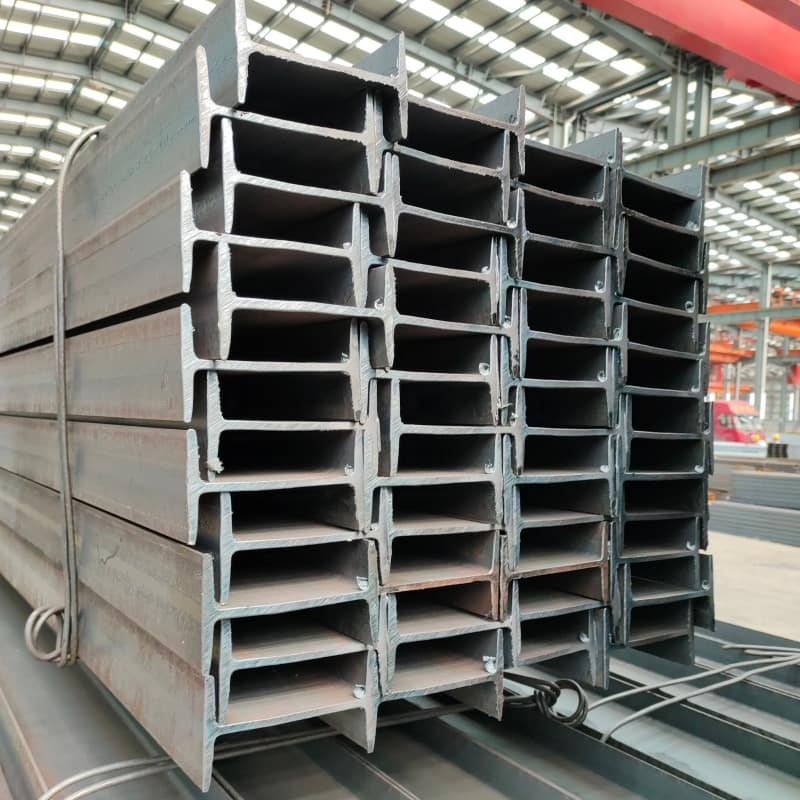
I-Beam (The “I” Shape) The I-beam, also known as a Universal Beam (UB) or Junior Beam, truly looks like the capital letter “I”. The horizontal elements (flanges) are narrow and usually have tapered edges. This means the flange gets thinner towards the outside. The connection between the web (the vertical part) and the flange is rounded.
H-Beam (The “H” Shape) The H-beam looks like the capital letter “H” when you turn it on its side. It is also called a Wide Flange Beam (W-Beam) in American standards. The flanges are much wider than those of an I-beam, and importantly, the inner and outer surfaces of the flanges are parallel. There is no taper. This makes welding and bolting other components to an H-beam much easier.
Load Bearing and Structural Strength
This is the most critical factor for engineers and procurement managers.
H-beams are generally heavier and stronger. Because the flanges are wider, they have a higher moment of inertia. In practical terms, this means H-beams are excellent at resisting bending and twisting forces. This is why you will see H-beams used as the main support columns in high-rise buildings and heavy industrial factories here in China and abroad.
I-beams are lighter. Their narrower flanges mean they cannot handle as much twisting force. However, they are highly efficient for handling vertical loads in one direction. They are perfect for hoist tracks, elevator shafts, or support frames where weight saving is a priority.
Production and Customization at Ruicheng Steel
From a manufacturing perspective, the production processes differ slightly.
I-beams are typically hot-rolled from a single piece of steel. Because of the tapered flanges, the rolling capability is limited to standard sizes.
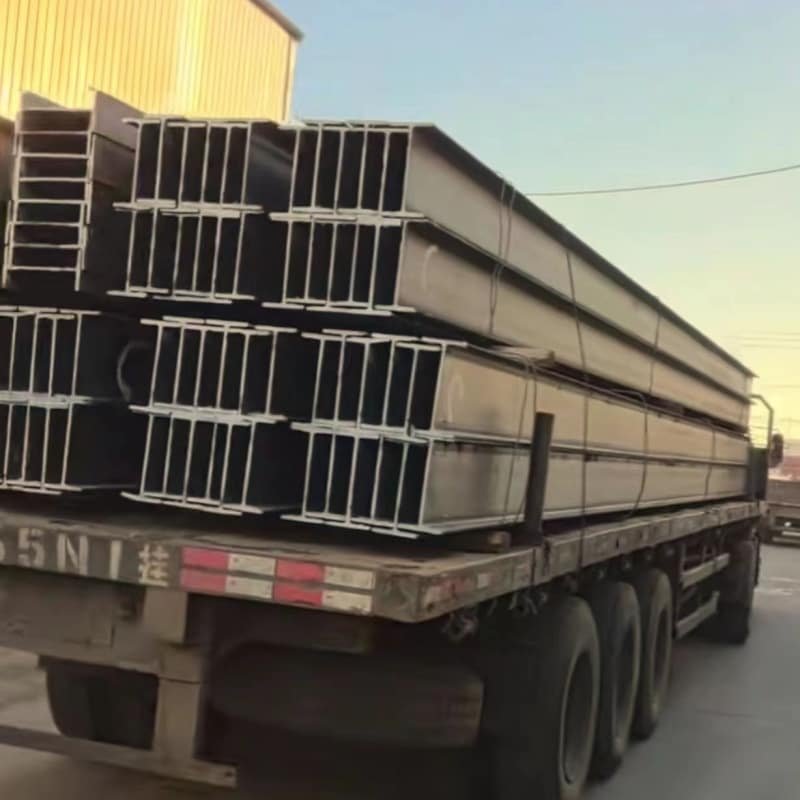
H-beams allow for more flexibility. At our Tangshan facility, we supply hot-rolled H-beams, but we can also produce built-up H-beams (welded H-beams) for non-standard sizes. If your project requires a specific web height or flange width that isn’t in the standard GB or ASTM catalog, we can manufacture it precisely to your specs.
Furthermore, we offer custom rolling services with negative tolerance control. Whether you need strict theoretical weight or a cost-saving negative tolerance (within safety standards), we can adjust our production line to suit your budget.
Price and Weight Comparison
For many of our international clients, the decision often comes down to cost.
Generally speaking, I-beams are lighter per meter than H-beams of a similar depth. If your structural engineer determines that the load doesn’t require the extra bulk of an H-beam, choosing an I-beam can save you money on material costs and ocean freight.
However, H-beams are more “efficient.” You might need fewer H-beams to support the same roof structure compared to I-beams.
Which One Should You Buy?
Here is our quick recommendation based on 15 years of export experience:
Choose I-Beams if: You are building frameworks for hoists, cranes, or lighter structural supports like truck beds and trailer frames. They are also excellent for short-span headers in residential construction.
Choose H-Beams if: You are constructing a large warehouse, a mezzanine floor, or a high-rise building. If the beam needs to span a long distance (over 30 feet) or support heavy concrete floors, the Wide Flange H-beam is the safer and more durable choice.
Conclusion
Understanding the mechanical properties of your steel is the first step to a successful project. Whether you need the heavy-duty strength of a Wide Flange H-beam or the lightweight efficiency of an I-beam, quality is non-negotiable.
At Ruicheng Steel, we stock a massive inventory of both profiles in common standards like ASTM A36, S355JR, and SS400. We are ready to help you analyze your drawings and suggest the most cost-effective steel solution.
Contact our team today for a current price list and let us help you ship the right steel to your port.