
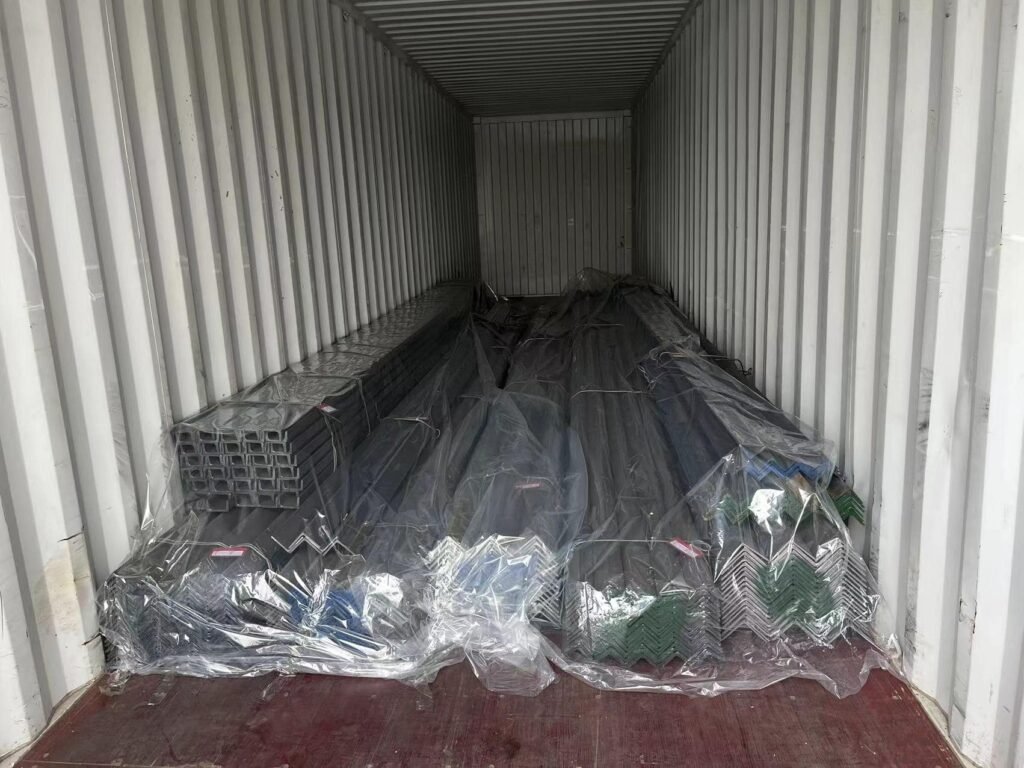
In the international steel trade, the “FOB price” (product price) is only half the story. For many of our clients in Africa, South America, and Southeast Asia, the “Landed Cost” (Product + Ocean Freight) is what truly matters. This is especially true when shipping structural steel.
When handling logistics, understanding the nuances of shipping structural steel is crucial. We have seen too many buyers make the same mistake: ordering a quantity or length that leaves the shipping container half-empty. Shipping “air” is the fastest way to kill your profit margins.
At Ruicheng Steel, our logistics team doesn’t just book ships; we optimize loading. We calculate every inch of space to ensure you get the lowest freight cost per ton. With a deeper understanding of the knowledge related to shipping structural steel, clients can better plan their transportation needs.
This guide will help you handle matters related to shipping structural steel more effectively. We will discuss the various factors you need to consider, from container selection to effective loading strategies.
Effective Strategies for Shipping Structural Steel
When selecting a container, ensuring effective loading is key. In this guide, we reveal the strategies we use to pack containers efficiently and how you can order smarter to save money.
The “Weight vs. Volume” Trap
Structural steel (H-beams, Channels, Angles) is heavy. Unlike shipping clothes or electronics, steel almost always hits the Maximum Weight Limit of a container before it fills the Volume Limit.
- 20ft Container (20GP): Can hold approx. 25–27 tons (depending on the shipping line).
- 40ft Container (40HQ): Can also hold approx. 26–27 tons.
Remember, understanding the specific length and weight limits is vital when shipping structural steel.
The misconception: Many clients think a 40ft container can hold double the weight of a 20ft container. It cannot. It can only hold double the volume.
Strategic Tip: If your order is heavy but short (under 5.8 meters), sticking to a 20ft container is usually cheaper because the Terminal Handling Charges (THC) are lower than a 40ft container.
The Critical Length Rule: 5.8m and 11.8m
This is the most common error we fix for new clients.
- For 20ft Containers: The internal length is roughly 5.89 meters.
- Mistake: Ordering “6-meter” bars. They won’t fit! You will have to cut them or switch to a pricey 40ft container.
- Solution: Order 5.8 meters (or 19ft).
- For 40ft Containers: The internal length is roughly 12.03 meters.
- Mistake: Ordering exact “12-meter” bars. It is too tight and makes unloading difficult.
- Solution: Order 11.8 meters (or 39ft).
By adjusting your design or cutting requirements to these standard “Container Lengths,” you ensure a smooth loading process and avoid extra “Break Bulk” shipping fees.
The Art of “Nesting” (How We Pack More)
Have you ever tried to stack H-beams or U-channels? If you stack them straight up, you create a lot of empty space in the middle. By optimizing the loading process, shipping structural steel can be done much more safely and efficiently.
At Ruicheng Steel, we use a technique called Nesting (Interlocking).
- For Channel Steel (U-shape): We flip every second piece upside down. The “legs” of the top piece fit inside the “belly” of the bottom piece.
- For H-Beams: Similarly, we interlock flanges to minimize the gap between layers.
Why does this matter? Even though steel is weight-limited, “Nesting” makes the bundle tighter and more stable (safer for sea transport). It also allows us to mix lighter goods (like small angles) on top of heavy H-beams if the weight limit hasn’t been reached yet.
Mixing Cargo: The “Combo” Load
Since a 40ft container has a lot of empty space (even after hitting the 26-ton weight limit with heavy beams), it is often wise to mix your order.
If you are buying Heavy H-Beams (which are dense), consider adding some Lightweight Rectangular Tubes or Roof Decking (which are bulky but light) to the same order.
By combining “Heavy” and “Light” products, you utilize both the Weight Limit and the Volume Limit of the container. This brings your average shipping cost per CBM down significantly.
How We Protect Your Steel During Voyage
Ocean transport is harsh. We understand the vulnerability of shipping structural steel during ocean transport; saltwater, humidity, and rough waves are enemies of steel.
At Ruicheng Steel, we take extra protective measures. We don’t just throw the steel in; we implement strict loading protocols:
- Dunnage: We place wooden blocks at the bottom to keep the steel off the container floor, preventing moisture accumulation.
- Lashing: We use steel wires and turnbuckles to strap the bundles to the container’s lash points. This prevents the steel from sliding and hitting the doors during storms.
- Ventilation: We ensure air vents are not blocked to reduce condensation (container rain).
Conclusion
In summary, shipping structural steel is a complex task, but proper planning pays off. Shipping shouldn’t be an afterthought; it should be part of your purchasing strategy. By ordering the right lengths (5.8m / 11.8m) and understanding the weight limits, you can save hundreds of dollars per container.
Don’t worry if you are not a logistics expert—that is our job. We can optimize the shipping structural steel transportation plan according to your specific needs.
When you request a quote from Ruicheng Steel, simply tell us your destination port. Our logistics team will calculate the optimal loading plan (Loading Calculation) for you, ensuring you don’t pay to ship empty air.
Want to check the shipping cost to your port?
Contact us today for a Free CIF Quotation and let us optimize your next shipment.